

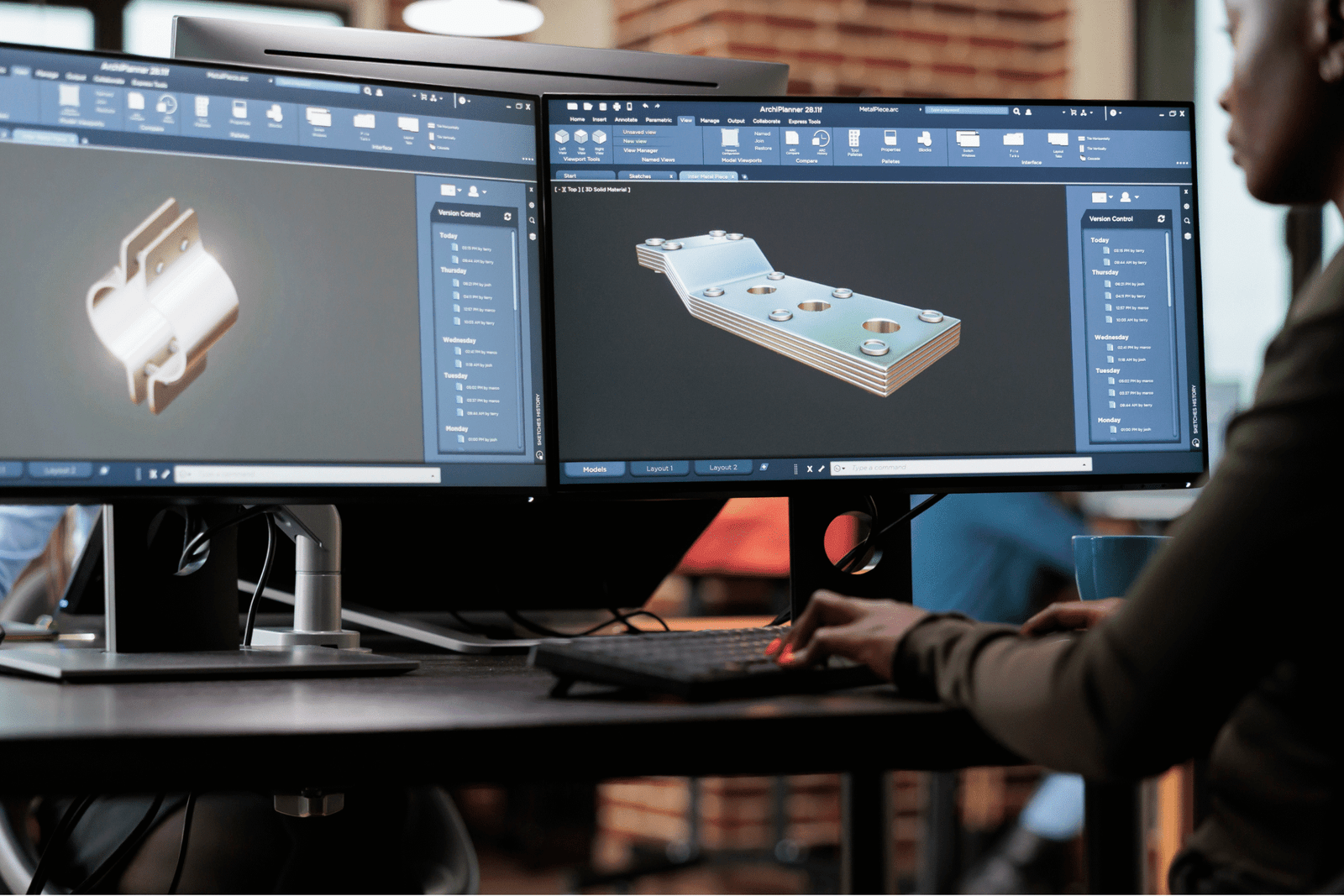
Construction is a documentation industry. For generations, 2D drawings have been the established go-to; they are accurate, and often flat, disconnected, and misinterpreted on any complicated job site. Now, project managers and contractors are moving on from stacks and stacks of paper to a more intelligent, collaborative, and visual option; 3D Construction Documentation.
Shifting workflows from computer-aided design (CAD) workflows into a dynamic 3D environment is not an advance in efficiency; it is a total reimagination of project delivery and risk. When utilizing Visual Technology in Construction, the project team is capable of working faster with accurate representations of what is being executed in the construction field, reducing errors in the Building Process; what is designed, what is built.
The Evolution: From Lines to Intelligence
What will truly concentrate efficiency is moving from straight lines to a 3D information model with rich information content. This represents the essence of the CAD to 3D Modeling Workflow.
While an original 2D drawing is required for many disciplines, it requires a significant amount of imagination and prior experience to properly understand how different types of systems (structural, mechanical, and architectural) will work together. All of which lead to a lot of RFIs and often expensive conflicts in the field.
The solution, as thought out smartly, is to move to BIM and 3D Design Integration Building Information Modeling (BIM) is not simply a geometric model, it adds a layer of information on all components. A 3D model of a wall is much more than four lines, it is a properly documented object that knows its material, fire rating, cost, and maintenance schedule.
Key Benefits of Visual Technology in Construction
Transitioning to a 3D Construction Documentation standard improves each phase of the project lifecycle:
- Error Reduction and Clash Prevention: The single most advantageous benefit of a 3D documentation strategy is proactive clash detection. When models of a building’s structure, MEP, and architecture are brought together, conflicts are identified in a virtual environment, well before they become costly rework on site. This one step and process can save a project thousands of dollars and weeks of delay.
- Better Communication with Stakeholders: A 3D model is easily understandable. Clients, foremen, and specialized contractors can all see exactly how the building is intended to be built, eliminating ambiguity and improving collaboration.
- Better Quantity Takeoffs (QTO): Every object within a BIM model is rich with data. The system can automatically create highly accurate material schedules and quantity takeoffs. Better takeoffs lead to more accurate bidding, less material waste, and better cost control (5D integration).
- Future-Proof Facilities Management: The 3D model is the “digital twin” of the completed building. This documentation is priceless for managing the building, maintaining the building, and future improvements to the building and its systems. The 3D file is information about every system in the building.
Geoshot: Your Partner in 3D Documentation
At Geoshot, we take pride in facilitating the digital transformation of your construction projects. Our 3D Construction Documentation specialists convert your legacy 2D data, drawings and plans into intelligent 3D BIM modeling.
Our team of specialists have perfected the CAD to 3D Modeling Workflow and work with the best BIM and 3D Design Integration software to create documentation that is flawlessly coordinated, clash free and visually stunning. We fill the void of traditional monochromatic 2d construction drawings through cutting edge 3d models, accurate digital quantity takeoffs, photorealistic renderings and comprehensive professional documentation.. We cover everything through design and completion processes.
Are you ready to put an end to the pain of inefficiencies, risks and constant reworking related to traditional 2D documentation? Start partnering with Geoshot today. Let us leverage the true transformative power of Visual Technology in Construction to now deliver projects on time and on budget.
Frequently Asked Questions

Founder & CEO
Bigyan Kar is the driving force behind Geoshot Technologies and has been since its founding, leading the company’s vision in delivering advanced CAD, GIS, graphics, map illustrations, and 3D solutions across multiple industries. While Geoshot serves a wide range of sectors, Bigyan has maintained a strong specialization in golf course graphics, CAD drafting, and mapping—ensuring highly accurate and visually compelling representations for golf architects and planners. His commitment to precision, visual clarity, and innovation has enabled Geoshot to produce high-quality 3D models, detailed maps, and comprehensive design visualizations for clients worldwide. Under his leadership, Geoshot Technologies has grown into a trusted partner for architects, planners, designers, and engineering teams by continuously investing in technology, talent, and workflow excellence. His ability to blend technical expertise with creative insight has established Geoshot as a leader in premium 3D visualization, CAD drafting, and mapping solutions across diverse sectors, with a distinguished reputation in the golf design industry.